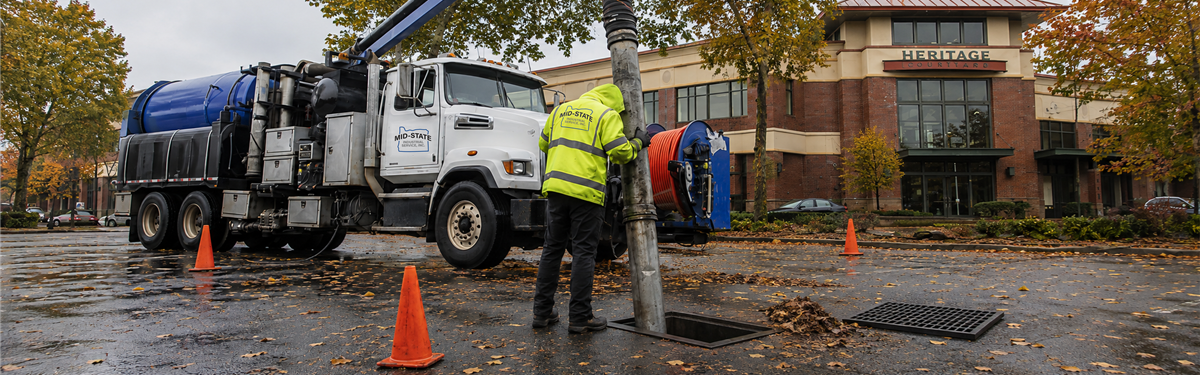
Parking lot sweeping and storm drain cleaning work together to clear debris and reduce flooding risk before Oregon’s heavy rains.
Stormwater problems rarely begin during the storm. They begin earlier, when leaves, sediment, trash, tire debris, and other material collect on paved surfaces or settle inside catch basins. By the time a parking lot is ponding, or a drain is overflowing, routine maintenance has become a corrective service call.
Across Oregon, municipalities, contractors, commercial properties, industrial facilities, and property managers rely on routine sweeping and stormwater system maintenance to reduce pollutant buildup, protect drainage capacity, and support maintenance records. Those records may also contribute to SWPPP documentation, SWMP annual reporting, MS4 permit files, and NPDES programs. The EPA NPDES Stormwater Program regulates certain stormwater discharges from municipal separate storm sewer systems, construction activities, and industrial activities, while the Oregon Department of Environmental Quality administers Oregon stormwater permitting.
Mid-State Industrial Service supports that field work with street sweeping, catch basin and storm drain cleaning, drain line jetting, CCTV storm and sewer inspection, and service documentation across Oregon. We do not replace engineers, permit administrators, or environmental consultants. Our role is the practical field execution that helps keep stormwater systems cleaner, more functional, and better documented.
Lane County route offer: Mid-State is accepting requests for cleaning at $59 per qualifying standard parking-lot drain. There is no per-property minimum. Properties are grouped by area, Mid-State selects the service date and time, and customers receive notice before the route is serviced. Full terms appear below.
Why Stormwater Maintenance Starts Before the Rain
Stormwater systems move rainwater away from roads, parking lots, industrial yards, construction sites, and paved commercial areas. The problem is that stormwater carries more than water. It can pick up sediment, trash, leaves, metals, oils, hydrocarbons, tire debris, construction material, and other pollutants before that runoff reaches a catch basin, storm drain, ditch, culvert, creek, river, or treatment system.
That is why stormwater programs rely on field maintenance. A stormwater plan may identify best management practices, inspection routines, or maintenance expectations, but the actual risk is reduced when the work happens on the ground. Paved surfaces need to be swept. Clean catch basins before they lose capacity. Jet drain lines when sediment compacts. Inspect pipes when recurring issues suggest a defect. Manage construction entrances and haul routes before track-out reaches public roads. The most effective time to do that work is before wet weather exposes the problem.
For municipal programs, the EPA municipal stormwater program and Oregon DEQ MS4 permit program provide the regulatory framework for municipal separate storm sewer systems. For construction sites, Oregon DEQ administers the 1200-C Construction Stormwater General Permit. For many industrial facilities, Oregon DEQ also administers industrial stormwater permits. In each case, field conditions matter because stormwater risk occurs where sediment, debris, pollutants, and drainage failures happen.
Common Stormwater Problems We See in the Field
Field problems usually develop gradually as small, visible conditions that are easy to overlook during normal operations. A dirty construction entrance becomes track-out. A partially filled catch basin becomes a flooded parking lot. A line with compacted sediment becomes a recurring backup. A paved industrial yard with accumulated material becomes a pollutant source during the next rain event.
Common field conditions that can increase stormwater risk include:
- Sediment and soil tracked from construction sites onto public roads, haul routes, and paved work areas.
- Leaves, trash, sand, gravel, and fine debris accumulating along curbs, parking lot edges, and drainage paths.
- Catch basins, inlets, sumps, and vaults filling with sediment, sludge, standing water, and organic material.
- Drain lines restricted by roots, grease, sediment, scale, construction debris, or compacted solids.
- Industrial yard debris, sawdust, process residue, sludge, or loose material collecting in areas exposed to rainfall.
- Recurring standing water that may indicate a blocked inlet, undersized maintenance schedule, pipe defect, or downstream restriction.
- Stormwater infrastructure located near utilities, vaults, or unknown underground conflicts where mechanical excavation would create unnecessary risk.
The goal of field maintenance is to address these conditions before they create flooding, complaints, production delays, inspection findings, or corrective-action pressure. Routine work is easier to group, schedule, and budget than emergency response after a drain backs up or a property starts to flood.
Sweeping Is Often the First Line of Stormwater Defense
Sweeping is one of the most visible and practical stormwater maintenance tasks because it removes material before it reaches the drainage system. The EPA identifies parking lot and street sweeping as a stormwater best management practice that can help reduce sediment, debris, trash, and other pollutants from paved areas. For Oregon municipalities, commercial properties, industrial facilities, and contractors, the same concept applies in different environments.
Street and road sweeping removes sediment, leaves, grit, trash, organic debris, and pollutants from municipal roads, private streets, industrial corridors, and paved public areas before the material reaches storm drains. For municipalities and public works departments, sweeping records can also support internal maintenance files and stormwater program documentation.
Parking lot sweeping helps property managers and facility owners reduce litter, leaves, sediment, tire debris, oils, and other material that collects on paved lots and eventually moves toward catch basins. Cleaner lots are easier to maintain, more professional for tenants and visitors, and less likely to contribute to localized drainage problems during Oregon rain events. Pairing scheduled sweeping with catch basin cleaning addresses debris both before it enters the drainage system and after it accumulates in the basin.
That is why Mid-State’s Lane County campaign includes a discounted parking-lot sweeping option for customers who request sweeping and route-based drain cleaning at the same time. The services address different parts of the same problem: sweeping removes surface debris before it reaches the drains, and catch basin cleaning removes material that has already accumulated.
Catch Basin & Storm Drain Cleaning Protects System Capacity
Sweeping reduces the amount of material that enters the drainage system, but it does not eliminate the need to clean the system itself. Catch basins, storm drains, inlets, sumps, vaults, and culverts are collection points. Their job is to receive runoff and capture material, but that also reduces their capacity over time.
When a catch basin fills with sediment, leaves, trash, sludge, or standing water, the system has less room to function during a storm. The result can be blocked drainage, street flooding, ponding in parking lots, overloaded downstream infrastructure, or recurring maintenance issues that become harder to ignore.
Catch basin and storm drain cleaning removes accumulated material from stormwater structures and helps restore flow capacity. During cleaning, experienced crews can also watch for visible issues such as blocked inlets, damaged grates, restricted flow, recurring sediment buildup, or conditions that may suggest a downstream pipe issue.
When the problem extends beyond the structure, drain line jetting can clear compacted sediment, roots, grease, sludge, scale, and other obstructions inside storm and sewer lines. Jetting breaks loose buildup, while vacuum recovery removes loosened material from the system. For recurring drainage issues, jetting and inspection often work best together because cleaning restores flow and CCTV inspection confirms what is happening inside the pipe.
Lane County Route-Based Storm Drain Cleaning
Mid-State’s route-based Lane County promotion is designed for routine, flexible maintenance at commercial properties. The public offer is $59 per qualifying standard parking-lot drain, with no per-property minimum. Service includes vacuum cleaning of accessible material, a visual condition check, and a service record.
Customers join a route request list rather than selecting a service appointment. Mid-State collects requests, groups nearby properties into an efficient truck route, selects the service date and time, and provides notice before service. This scheduling flexibility makes the promotional price possible.
The $59 rate does not apply to customer-selected dates or times, active flooding, rush calls, emergency response, after-hours work, or off-route service. Mid-State can still respond to those needs at standard rates. Oversized or nonstandard structures, inaccessible material, jetting, repairs, and other additional work are quoted separately.
CCTV Inspection Turns Field Conditions Into Useful Documentation
The visual condition check included with route cleaning can identify conditions visible at the structure, but it can’t confirm some stormwater problems from the surface. A catch basin may look clean while the downstream pipe remains blocked. A parking lot may flood repeatedly because of a pipe sag, separated joint, root intrusion, or structural defect. A construction project may need proof that existing infrastructure was inspected before closeout. In these situations, video inspection provides the condition data needed to make informed decisions.
CCTV storm and sewer line inspection allows crews to inspect underground storm and sewer lines without excavation. Mid-State provides NASSCO-certified inspection and PACP-coded reporting, giving municipalities, engineers, contractors, property managers, insurance carriers, and compliance teams clear records that can support maintenance decisions, repair planning, project closeout, and regulatory files. NASSCO describes PACP as a standardized condition coding program for pipelines, laterals, and manholes that helps system owners evaluate and manage assets based on condition information. Learn more about PACP through NASSCO.
For stormwater maintenance, CCTV inspection is especially useful when a line has recurring backups, poor flow, unknown conditions, or when you need documentation after cleaning. A jetted line gives the camera a cleaner view. The camera then helps identify whether the problem was only buildup or an underlying defect that requires repair, monitoring, rehabilitation, or further engineering review.
Documentation Matters, But It Starts With the Work
Stormwater documentation is only useful when it reflects work that actually happened. Maintenance records, service reports, GPS verification, CCTV video, PACP-coded inspection data, and project notes can help demonstrate that a site, facility, or municipal program is actively maintaining stormwater infrastructure and responding to known field conditions.
For municipalities, service records may support SWMP annual reports, MS4 permit files, and public works maintenance tracking. For construction contractors, records may support SWPPP files, inspection follow-up, project closeout, and corrective-action documentation. For industrial facilities, records may support internal maintenance programs, environmental files, and stormwater housekeeping practices. For commercial properties, records can help document routine maintenance of paved areas, catch basins, and drainage systems.
Mid-State supports documentation through the work itself. Sweeping routes can be recorded. Catch basin cleaning can be tracked. Mid-State can document jetting and vacuum recovery. CCTV inspection can provide video and condition reports. Fleet GPS and operational tracking also help verify route completion, service activity, time on site, and dispatch efficiency. Mid-State explains more about this capability on the Equipment page, where GPS tracking, verified service documentation, and fleet management are part of the company-wide operating model. For the Lane County route promotion, the service record documents the routine cleaning performed and visible conditions observed. It is not a CCTV inspection, engineering evaluation, or compliance certification.
Documentation does not guarantee compliance on its own. It is a support tool. The stronger foundation is a maintenance program that keeps paved surfaces clean, drainage structures open, pipes inspected, and field issues addressed before they become bigger operational or compliance problems.
Routine Maintenance & Corrective Action Require Different Scheduling
Stormwater maintenance usually falls into two categories: planned maintenance and corrective action. Planned maintenance is scheduled before problems become urgent and lets you efficiently group multiple properties or structures. Corrective action happens after a site is flagged, a drainage issue appears, a complaint is made, or a system stops performing as expected.
Planned maintenance may include routine street sweeping, seasonal catch basin cleaning, pre-rain drain line jetting, parking lot sweeping, industrial yard cleaning, or recurring CCTV inspection of priority assets. This approach helps customers reduce pollutant buildup, maintain system capacity, and spread maintenance work across a predictable schedule. Mid-State’s $59 Lane County route offer belongs in this planned-maintenance category.
Corrective action is different. A site may need fast field response for track-out, blocked drainage, sediment buildup, standing water, recurring backups, flooded inlets, or other stormwater maintenance concerns. Those needs require immediate or fixed scheduling and are billed at standard rates, even when the property has also joined a promotional route list. One coordinated contractor can still help reduce delays by dispatching the right combination of sweeping, vacuum recovery, jetting, CCTV inspection, water truck support, and service documentation.
This is especially important in Oregon, where wet weather can quickly turn a minor maintenance issue into a larger problem. A catch basin that is partially full in dry weather may overflow during a storm. A small amount of track-out may become a visible sediment pathway after rain. A drain line with compacted material may back up when flows increase. The faster you address field conditions, the easier they are to control.
Why One Field Contractor Makes Stormwater Maintenance Easier
Stormwater maintenance often requires more than one truck and more than one discipline. A property manager may start with parking lot sweeping and discover a blocked catch basin. A contractor may schedule water trucks for dust control and need construction sweeping after haul traffic increases. A municipality may clean catch basins and discover that a downstream pipe requires jetting and CCTV inspection. An industrial facility may need vacuum recovery, hydroblasting, and waste coordination as part of a maintenance shutdown.
Working with one field-service contractor can simplify that process. Mid-State operates a statewide fleet that includes sweepers, vacuum trucks, jetting equipment, CCTV inspection vehicles, hydro excavation units, water trucks, tankers, and industrial cleaning equipment. That fleet depth reduces mobilization delays, improves coordination, and keeps work moving when field conditions change.
Mid-State provides statewide service across Oregon, including the Portland Metro, Willamette Valley, Central Oregon, Oregon Coast, Southern Oregon, and surrounding regions. In the Portland Metro service area, stormwater maintenance often intersects with MS4 programs, Clean Water Services requirements, PBOT work, county road departments, private development, industrial operations, and major transportation corridors. Across Oregon, the same principle applies: cleaner surfaces, clear drainage infrastructure, and documented work help customers avoid problems.
Prepare Before the Rain With Routine Field Maintenance
Permits, plans, and records matter, but the most useful stormwater maintenance happens before rainfall exposes a problem. Sweep track-out before it reaches public roads. Remove parking lot debris before it enters catch basins. Clean catch basins before they lose capacity. Jet drain lines before compacted material causes a backup. Use CCTV inspection when recurring problems suggest an underground defect. Then document the work for maintenance, project, and compliance files.
Mid-State Industrial Service helps Oregon municipalities, contractors, industrial facilities, commercial properties, and property managers keep stormwater systems cleaner through practical field services and reliable documentation support. Whether the need is routine maintenance, standard-rate urgent response, construction support, industrial cleaning, or inspection follow-up, our crews bring the equipment, experience, and statewide dispatch capability to keep stormwater work moving.
Lane County businesses can join Mid-State’s route-based cleaning list for $59 per qualifying standard parking-lot drain, with no per-property minimum, and ask about discounted parking-lot sweeping when both services are requested together. Mid-State selects the route date and time and provides notice. Customer-selected appointments, active flooding, rush or emergency response, after-hours work, and off-route service are available at standard rates.
Need stormwater field support elsewhere in Oregon? Contact Mid-State Industrial Service or call (541) 726-6730 to discuss sweeping, catch basin cleaning, drain line jetting, CCTV inspection, or coordinated maintenance documentation for your site or project.