




When Drains Fail, Everything Downstream Suffers
Catch basins and storm drains are a critical part of a stormwater management system. When sediment, trash, leaves, and other debris accumulate, drainage capacity can decline, contributing to standing water, localized flooding, roadway hazards, and potential maintenance or permit-compliance concerns.
Mid-State Industrial Service provides catch basin and storm drain cleaning throughout Oregon for municipalities, commercial properties, industrial facilities, HOAs, and construction sites. Using high-capacity combination jetter and vacuum equipment, our crews remove accumulated sediment, debris, trash, and standing water to improve drainage capacity and support routine stormwater-system maintenance. Customers can also coordinate related services such as street sweeping, drain line jetting, and CCTV storm sewer inspection to address debris before it enters the drainage system, clean connected piping, and document visible conditions below the surface.
During cleaning, our crews note visible conditions such as damaged grates, recurring sediment buildup, standing water, restricted flow, and blocked inlets. When these conditions suggest a problem within the connected piping, Mid-State can recommend CCTV inspection for a closer look below the surface.
Who We Serve
We provide catch basin and storm drain cleaning for:
Municipal Public Works Departments
Scheduled and on-call cleaning for municipal catch basins, curb inlets, storm drains, culverts, and connected drainage systems, with service documentation available to support maintenance records and MS4 program requirements.
Commercial Property Owners & Managers
Cleaning for private catch basins, parking-lot drains, inlets, and drainage structures to address sediment buildup, standing water, debris accumulation, and recurring drainage concerns.
Industrial Facilities
Cleaning of suitable stormwater structures, paved-yard drainage, inlets, and catch basins at industrial facilities. We review material type, contamination concerns, access, and disposal requirements before service.
Construction Site Operators
Cleaning for temporary and permanent drainage structures affected by construction sediment, track-out, aggregate, and site debris, helping contractors support erosion-control and stormwater-maintenance plans.
HOAs & Property Management Companies
Routine and on-call cleaning for private streets, community catch basins, curb inlets, parking-area drains, and shared stormwater systems.
ODOT & Highway Contractors
Catch basin, inlet, culvert, and storm-drain cleaning for highway maintenance, roadway construction, and transportation-infrastructure projects.
What We Remove
Catch basins collect sediment, trash, oils, metals, and other pollutants from roadways, parking lots, industrial yards, and construction activity. As this material builds up, it reduces sump capacity, restricts stormwater flow, and increases the risk of backups, flooding, and downstream water-quality issues.
Common materials collected during catch basin and storm drain cleaning include:
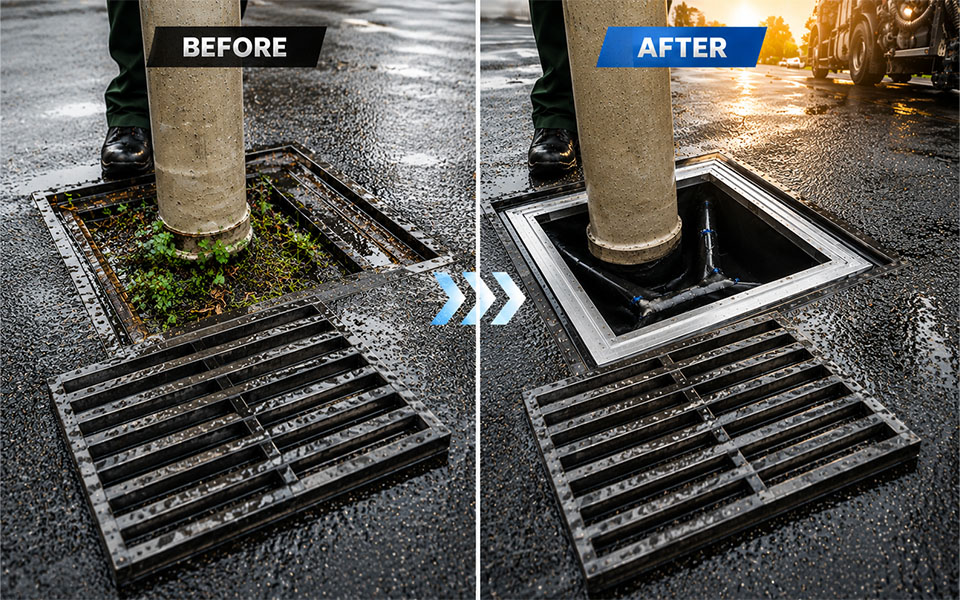
- Sediment and Silt: Fine particles that compact and reduce catch basin sump capacity.
- Debris and Trash: Leaves, plastic, organic material, and general waste.
- Oily Residue and Petroleum-Affected Material: Material associated with vehicle traffic, equipment activity, or minor surface deposits, subject to review and applicable disposal requirements.
- Sediment Containing Roadway Pollutants: Fine material that may contain metals and other contaminants associated with vehicle traffic, runoff, and industrial activity.
- Gravel and Aggregate: Loose material from construction activity, roadway wear, and paved surfaces.
If accumulated material is not removed, it can reduce storage capacity and may be carried farther into the drainage system or downstream receiving waters. Routine street sweeping can complement catch basin maintenance by reducing the amount of sediment, litter, and loose roadway debris that reaches storm-drain inlets.
Our Storm Drain Cleaning Process
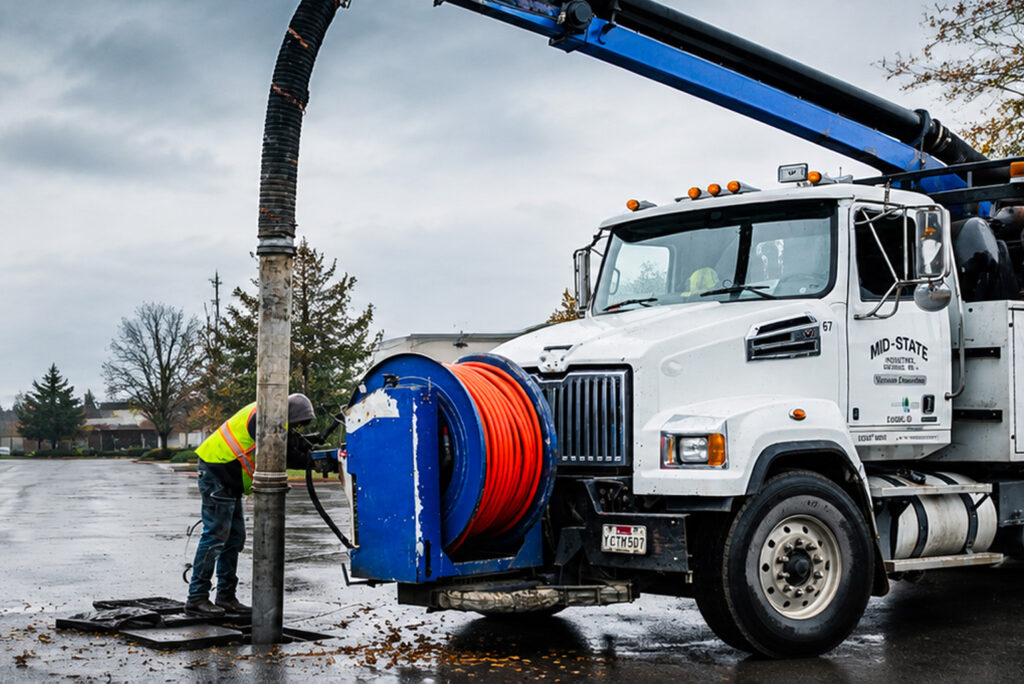
Mid-State uses a combination of jetter and vacuum trucks to remove sediment, debris, standing water, and accessible blockages from catch basins, storm drains, culverts, and related drainage structures. When connected piping requires additional cleaning, we can add drain line jetting to remove accumulated material and improve flow through accessible sections of the system.
Site Assessment
Before cleaning begins, we review the structure’s location, accessibility, visible condition, estimated material volume, and connection to the surrounding drainage system.
Vacuum Extraction
High-powered vacuum equipment removes accumulated sediment, debris, trash, and standing water from the system.
Jetting If Needed
When compacted material or buildup extends into connected piping, high-pressure drain line jetting may be used to loosen and move the material for vacuum removal. After cleaning, CCTV inspection can document visible pipe condition and help identify remaining obstructions or defects.
Waste Handling
Collected material is handled according to its source, characteristics, customer instructions, receiving-facility requirements, and applicable disposal regulations. Material with suspected contamination may require additional review or testing before transport and disposal.
Documentation
Upon request, Mid-State can provide service records to support customer maintenance files, stormwater-program documentation, and facility recordkeeping.
Catch Basin Protection
Where appropriate, Mid-State can install or maintain approved catch basin protection devices as a separate service. Product selection, inspection frequency, maintenance, and disposal requirements depend on the site and intended application.
Supporting Stormwater Maintenance & Permit Requirements

Municipalities and certain industrial or commercial facilities may operate under NPDES permits, local stormwater programs, or site-specific requirements that include inspection and maintenance of drainage infrastructure. Catch basin and storm-drain cleaning can be an important maintenance practice, but the required frequency, documentation, and disposal procedures depend on the applicable permit, facility, and local program.
Inadequate stormwater-system maintenance can contribute to:
- Reduced drainage capacity and localized flooding.
- Sediment and debris moving farther into the stormwater system.
- Increased maintenance and repair needs.
- Permit or inspection concerns when required maintenance is not completed.
- Corrective actions or enforcement when applicable permit conditions are not met.
Why Choose Mid-State Industrial Service
High-Capacity Vacuum Trucks
Built for heavy sediment loads and large storm drain systems.
24/7 Emergency Dispatch
After-hours dispatch and responsive scheduling for urgent drainage problems, subject to equipment availability and site conditions.
Stormwater-Maintenance Experience
Our team understands how catch basin cleaning, service records, material handling, and related maintenance can support municipal and facility stormwater programs.
Statewide Coverage
Serving Oregon from the coast to Eastern Oregon.
55+ Years of Experience
Trusted by municipalities, contractors, property managers, and facility operators throughout Oregon.
Equipment Used for Catch Basin & Storm Drain Cleaning
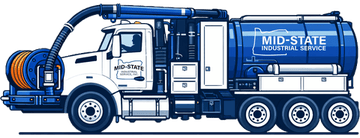
Mid-State operates a Western Star Sewer Equipment ECO900 combination sewer cleaner for catch basin, storm drain, culvert, and connected drainage-system maintenance.
- High-pressure jetting & vacuum recovery in a single truck supports efficient cleaning and material removal.
- Compacted sediment, sludge, debris & accessible blockages are removed to restore drainage capacity.
- Standing water, sediment, trash & loosened material recovery from catch basins and drainage structures.
- Catch basin, inlet, culvert & connected storm-drain maintenance is supported by the equipment configuration.
- The unit can handle scheduled cleaning, project support & urgent drainage-service needs.
Best for: Catch basins, storm drains, curb inlets, culverts, drainage-system maintenance, and accessible blockage removal.
Service Areas
Mid-State Industrial Service provides catch basin and storm drain cleaning throughout Oregon. Crews and equipment can also mobilize for select projects in Southern Washington, Western Idaho, and Northern California.
Portland Metro
Multnomah, Washington, and Clackamas counties and surrounding areas.
Salem & Mid-Willamette Valley
Marion, Polk, and surrounding counties.
Eugene & Springfield
Lane County and surrounding areas.
Bend & Central Oregon
Deschutes County and Central Oregon communities.
Roseburg & Southern Oregon
Douglas, Jackson, Josephine, and surrounding counties.
Eastern Oregon
Mobilization available for municipalities, commercial properties, industrial facilities, and project sites throughout Eastern Oregon.
Call (541) 726-6730 to discuss your location, drainage system, access conditions, and scheduling needs.
Combine Cleaning & CCTV Inspection
Cleaning removes accumulated material, but it may not explain why drainage problems keep returning. When a system has repeated blockages, slow drainage, sinkholes, settlement, or recurring sediment buildup, CCTV inspection can provide a closer look inside accessible piping.
After cleaning, Mid-State’s trained inspection team can document visible conditions such as cracks, joint separation, root intrusion, deformation, offset joints, remaining obstructions, and other pipe defects. Cleaner lines generally provide clearer footage and a more useful inspection record.
Combining the services can help municipalities, property managers, industrial facilities, commercial sites, and contractors coordinate cleaning and inspection through one provider while gathering information for maintenance planning and repair decisions.

Why Combine Cleaning & CCTV Inspection
- Clearer inspection footage: Cleaning removes sediment and debris that can obstruct the camera’s view.
- Coordinated scheduling: Cleaning and inspection may be completed during the same mobilization when equipment, access, and scheduling allow.
- Condition documentation: Inspection footage and reports can support maintenance planning, engineering review, and customer records.
- Visible defect identification: CCTV can document cracks, root intrusion, joint separation, deformation, and other observable conditions.
- Better repair planning: Inspection findings can help customers determine which areas may need further evaluation, repair, or replacement.
Dealing with a drainage problem that keeps returning? Ask about coordinating storm drain cleaning with CCTV inspection for a clearer view of the accessible piping and documented conditions below the surface.
Frequently Asked Questions
How often should catch basins be cleaned?
Cleaning frequency depends on the applicable permit or maintenance program, sediment accumulation, surrounding land use, traffic, construction activity, seasonal leaf fall, and drainage history. Some systems are cleaned on a recurring schedule, while others are inspected and cleaned when accumulated material reaches an established maintenance threshold. Mid-State can help document site conditions and develop a practical service schedule, but the system owner remains responsible for determining applicable permit requirements.
What happens to the material you remove?
Material handling depends on where the sediment came from, its characteristics, the customer’s disposal plan, and the receiving facility’s requirements. Mid-State can coordinate transport and disposal for accepted material. Suspected contamination or material from certain industrial areas may require testing, profiling, or additional approval before disposal.
Can you clean drains during a rain event?
Mid-State provides 24/7 emergency dispatch for urgent drainage problems, including requests during active weather events. Whether cleaning can proceed safely depends on rainfall, traffic, flooding, access, water levels, equipment availability, and site conditions. Routine cleaning is generally easier to complete under stable conditions.
Can you provide service documentation?
Yes. Upon request, Mid-State can provide service records for customer maintenance files, stormwater-program documentation, and internal reporting. Available details may include the service date, location, structures cleaned, and relevant job notes.
When It Clogs, We Clear It
Address sediment buildup, recurring drainage problems, and blocked inlets before they lead to larger maintenance concerns.
24/7 emergency dispatch available, with statewide coverage across Oregon.