




See What’s Happening Inside Your Pipeline Without Digging
Pipe defects can develop out of sight. Cracks, offset joints, root intrusion, deformation, sediment buildup, and structural deterioration may contribute to backups, reduced capacity, sinkholes, or eventual pipe failure when they are not identified and addressed.
CCTV pipeline inspection provides a real-time view inside accessible storm and sewer lines without exploratory excavation. Mid-State Industrial Service provides HD video inspection throughout Oregon using PACP-certified operators and standardized condition coding. Municipalities, contractors, industrial facilities, and property managers can use the resulting footage and reports to document visible pipe conditions, prioritize maintenance, and plan repairs.

What CCTV Inspection Identifies
Using a self-propelled crawler camera, our operators record high-definition video and document visible conditions throughout accessible portions of the pipeline.

- Cracks and Fractures: Longitudinal, circumferential, spiral, and other visible cracking in pipe walls.
- Joint Defects: Offset joints, open joints, separated connections, and visible infiltration points.
- Root Intrusion: Fine roots, root masses, and root balls that restrict flow or enter through pipe joints and defects.
- Sediment and Debris Accumulation: Buildup that reduces available capacity, obstructs the camera, or indicates recurring drainage concerns.
- Structural Deformation: Deflection, out-of-round conditions, visible collapse, and changes in pipe shape.
- Service Lateral Connections: Visible condition and alignment of lateral connections encountered during the inspection.
- Infiltration and Inflow: Visible groundwater or surface-water entry into the inspected system.
Who We Serve
Municipal Public Works Departments
CCTV inspection and PACP-coded reporting for municipal storm and sanitary sewer systems, supporting condition assessment, maintenance planning, project documentation, and asset-management programs.
Public Agencies & Highway Contractors
Inspection of accessible culverts, storm drains, and roadway drainage piping for maintenance, construction, rehabilitation, and project closeout needs.
Commercial & Industrial Property Owners
Inspection of private storm and sewer piping to document visible blockages, defects, deterioration, and other conditions that may affect drainage or future maintenance.
Construction Contractors
Pre-construction, post-construction, and project-closeout inspections that document visible pipe conditions before and after work near existing underground infrastructure.
GIS-Compatible PACP Reporting
PACP-coded inspection data can be prepared for use with compatible GIS, maintenance-management, and asset-management systems when customer specifications and required file formats are confirmed before the project.
Facility Managers
CCTV inspection for recurring drainage problems, suspected pipe damage, and underground infrastructure assessments before maintenance, repairs, renovations, or facility-expansion projects.
PACP-Certified Operators. Standardized Condition Reporting.
Mid-State’s PACP-certified operators use the Pipeline Assessment Certification Program to classify and record observable pipe conditions through standardized codes. This consistent approach helps municipalities, engineers, contractors, and system owners compare findings across pipe segments and inspection cycles.
Standardized Defect Coding
Observable pipe conditions are recorded using standardized PACP codes, creating consistent inspection data that qualified reviewers can compare across pipe segments, projects, and inspection cycles.
Recorded Video
Digital video records the accessible portions of each inspected pipe segment, providing visual documentation of observable defects, obstructions, connections, and maintenance concerns.
Condition Scoring
When included in the project scope, PACP structural and operation-and-maintenance scores summarize coded conditions and support asset comparison, maintenance planning, and further evaluation.
Actionable Reports
Clear inspection reports support maintenance prioritization, rehabilitation planning, project documentation, and asset-management decisions. Delivery timing depends on project size, reporting requirements, data review, and the requested file format.
Public agencies, utility owners, engineers, and contractors may specify PACP coding, database formats, video standards, or other project-specific deliverables for CCTV inspection work. Mid-State can confirm reporting requirements before the inspection so the resulting footage, condition data, and supporting files align with the agreed project scope.
Laser Profiling & Deflection Testing
For suitable pipes where deformation or changes in cross-sectional shape are a concern, Mid-State also offers laser profiling and deflection testing. This service is commonly used for large-diameter storm piping, corrugated metal pipe, high-density polyethylene pipe, and aging concrete infrastructure. The resulting measurements can support engineering review, condition assessment, rehabilitation planning, and capital-improvement decisions.
These inspections help assess:
- Pipe Deflection: Measurements showing changes from the pipe’s intended shape.
- Cross-Sectional Profile: Dimensional information used to evaluate the pipe’s interior shape and available area.
- Engineering Review Data: Recorded measurements that can support further structural evaluation, rehabilitation planning, and long-term asset management.
Pair CCTV Inspection with Drain Line Jetting
Clean the line first for a clearer, more accurate camera run.
CCTV inspection shows what is happening inside the pipe, but only when the camera has a clear path. Sediment, grease, roots, sludge, scale, and debris can block the view and hide cracks, offsets, infiltration, low spots, and other defects.
Drain line jetting can remove accumulated material before inspection, helping the camera capture a more complete view of accessible pipe walls, joints, connections, and visible defects. For lines with recurring backups, restricted flow, or unknown conditions, Mid-State can coordinate jetting, CCTV inspection, and PACP-coded reporting during the same service visit when site conditions and scheduling allow.

Why Combine Jetting & CCTV Inspection
- Improve Camera Visibility: Jetting removes accumulated material that can obstruct the camera’s path or hide portions of the pipe wall.
- Investigate Recurring Problems: CCTV inspection can document visible sags, offset joints, root intrusion, cracks, infiltration, deformation, and obstructions that cleaning alone cannot correct.
- Document Post-Cleaning Conditions: A follow-up inspection records the accessible line after cleaning and identifies any remaining visible material or defects.
- Coordinate Related Services: Mid-State can provide drain line jetting and CCTV inspection through one service provider, reducing the need to schedule separate contractors.
- Create Standardized Records: PACP-coded reporting and inspection footage provide consistent documentation for maintenance planning, engineering review, project closeout, and customer files.
If you are scheduling a CCTV inspection for a line with buildup, poor flow, recurring backups, or unknown conditions, ask about pairing the inspection with drain line jetting. We can clean the line, inspect the pipe, and document the results in one coordinated visit.
Why Choose Mid-State Industrial Service
PACP-Certified Operators
Standardized condition coding and inspection reporting.
Experienced Camera Operators
Trained in camera operation, observable pipe-condition assessment, and standardized PACP coding.
Full-Service Capability
Coordinate CCTV inspection with drain line jetting, catch basin cleaning, or hydro excavation through one service provider.
24/7 Emergency Dispatch
After-hours dispatch for urgent inspection and drainage-service needs, subject to access, flow conditions, and equipment availability.
Statewide Coverage
Serving Oregon municipalities, contractors, and facility managers.
Equipment Used for CCTV Inspection
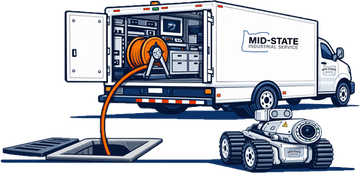
Mid-State operates a Ford F-450 CCTV inspection truck equipped with an iBAK by RapidView HD crawler-camera system for inspecting accessible sewer lines, storm drains, culverts, and other underground piping.
- The self-propelled crawler camera travels through accessible pipe systems without exploratory excavation.
- HD pan-and-tilt camera provides real-time viewing, digital recording, and visual inspection documentation.
- 6-inch and larger pipe inspection capability supports suitable sewer lines, storm drains, culverts, and underground piping.
- PACP-coded reporting & condition assessment are supported through the inspection software.
- Laser profiling & deflection testing are available for qualifying pipe sizes, materials, and project conditions.
Best for: Sewer and storm-drain inspection, culvert inspection, visible pipe-condition assessment, pre-construction documentation, post-cleaning inspection, and PACP-coded reporting.
Service Areas
Mid-State Industrial Service provides CCTV storm and sewer line inspection throughout Oregon. Crews and equipment can also mobilize for select projects in Southern Washington, Western Idaho, and Northern California.
Portland Metro
Multnomah, Washington & Clackamas counties.
Salem & Mid-Willamette Valley
Marion, Polk & surrounding counties.
Eugene & Springfield
Lane County & surrounding areas.
Bend & Central Oregon
Deschutes County & Central Oregon communities.
Roseburg & Southern Oregon
Douglas, Jackson, Josephine & surrounding counties.
Eastern Oregon
Mobilization available for municipalities, contractors, facilities & project sites throughout Eastern Oregon.
Call (541) 726-6730 to discuss your project location, pipe sizes, access points, reporting requirements, and scheduling needs.
Frequently Asked Questions
What is PACP coding, and why does it matter?
PACP, the Pipeline Assessment Certification Program, is NASSCO’s standardized system for coding observable pipeline conditions. Consistent coding helps system owners, engineers, municipalities, and contractors compare inspection findings and use the data for maintenance, rehabilitation, and asset-management planning.
Do you provide video footage along with the report?
Yes. Digital video footage is available with the inspection, and PACP-coded condition reporting can be included according to the agreed project scope and customer requirements.
How long does a CCTV inspection take?
Inspection time depends on the number and length of pipe segments, pipe diameter, access, flow, debris, cleaning needs, and required documentation. Contact Mid-State with the project scope for a scheduling and duration estimate.
Should I clean the pipes before inspection?
Cleaning is recommended when sediment, grease, roots, sludge, scale, or other material may obstruct the camera or hide pipe conditions. Mid-State can coordinate drain line jetting and CCTV inspection during the same mobilization when appropriate.
What pipe sizes can Mid-State inspect with CCTV equipment?
Mid-State’s crawler-camera system can inspect suitable storm drains, sewer lines, culverts, and underground piping measuring 6 inches and larger. Actual access depends on pipe diameter, material, bends, flow, debris, entry points, and the camera configuration required for the project.
Can Mid-State inspect a pipe that is blocked or full of sediment?
A heavily obstructed pipe may need drain line jetting or vacuum cleaning before a complete CCTV inspection can be performed. Cleaning helps provide a clearer camera path and improves visibility of accessible pipe walls, joints, connections, and defects.
Know the Condition of Your Pipes
Don’t wait for a failure to find out what’s in your pipes.
24/7 emergency dispatch available; statewide coverage across Oregon.