


Industrial Tank Cleaning for Demanding Maintenance Projects
Tank buildup can reduce usable capacity and interfere with inspection, maintenance, and product quality. Storage tanks, process vessels, and holding systems may accumulate sludge, sediment, scale, residue, biological growth, and corrosion byproducts over time. The type and severity of buildup depend on the stored material, tank design, operating conditions, and cleaning history.
Mid-State Industrial Service provides tank cleaning throughout Oregon using industrial vacuum equipment, hydroblasting systems, tanker support, and trained personnel. Before work begins, the project team reviews tank contents, access, isolation, atmospheric hazards, confined-space status, waste handling, surrounding operations, and the facility’s required cleaning result.

Tank-cleaning projects can also be coordinated with hydroblasting, industrial vacuum recovery, drain line jetting, and related wastewater-system cleaning during shutdowns, seasonal maintenance, or facility upgrades. Combining these services through Mid-State can simplify scheduling and reduce the number of separate contractors involved.
Our Tank Cleaning Process
Mid-State combines industrial vacuum trucks, hydroblasting equipment, tanker support, and trained crews for sludge removal, tank-interior cleaning, maintenance preparation, and recovery of accepted materials.
Pre-Job Assessment
Before work begins, we review tank contents, available safety data, access points, isolation requirements, confined-space status, known hazards, cleaning specifications, water needs, containment, and waste-handling considerations.
Detailed Proposal
When requested, you can receive a written scope outlining the proposed equipment, cleaning methods, access requirements, safety responsibilities, containment plan, estimated schedule, staffing needs, waste-handling assumptions, and pricing before mobilization.
Safe Entry Setup
The crew establishes isolation, exclusion zones, ventilation, atmospheric monitoring, communication, PPE, equipment controls, and other site-specific safeguards before cleaning begins. When personnel entry is required, the team also coordinates the applicable confined-space permit, attendant, entrant, supervision, and rescue procedures.
Tank Cleaning
The team removes sludge, residue, sediment, and other buildup using industrial vacuum recovery, hydroblasting, manual tooling, or a combination of methods selected for the tank contents, configuration, substrate, access, and required cleaning result.
Waste Handling
Collected liquids, sludge, sediment, and loosened material are handled according to the material source, available characterization, facility instructions, receiving-location requirements, and the agreed service scope. The team reviews material requiring testing, profiling, special transport, or regulated disposal with the customer and qualified waste-management partners before removal.
Post-Cleaning Verification
The team reviews the completed cleaning area against the agreed scope and documents relevant conditions before determining whether the tank is ready for inspection, repair, coating, sanitation, reassembly, or return to service. Project records can also be provided for maintenance files and waste-handling documentation.
3D Rotary Jet Tank Cleaning
Mid-State provides 3D rotary jet tank cleaning throughout Oregon using Jetstream rotating nozzles and high-pressure hydroblasting equipment. We lower the cleaning head through a suitable tank opening. As it rotates on two axes, the water jets sweep accessible interior surfaces to loosen residue, scale, and process buildup.
Our system can operate at up to 21,000 PSI, with the pressure and nozzle setup selected for the tank material, lining, deposits, and required cleaning result.
- Rotating coverage: Jets sweep exposed tank walls, floors, and other reachable interior surfaces.
- Cleaning from outside: Suitable tanks can be cleaned through an access opening, reducing the need for personnel entry during this stage.
- Vacuum recovery: Industrial vacuum equipment can collect loosened material and cleaning water as part of the agreed service scope.

Planning a shutdown, inspection, or tank-maintenance project? Share your tank dimensions, contents, access-opening size, internal components, and cleaning requirements. We will review the best approach, including any additional cleaning, entry, and material-handling needs.
What Tank Cleaning Addresses
Tank interiors can accumulate sludge, scale, residue, biological growth, and corrosion byproducts that reduce usable capacity, affect product quality, interfere with inspections, and create contamination risks. The specific buildup depends on what the tank stores, how the system operates, and how long it has been since the last cleaning.

- Sludge and Sediment: Settled solids that occupy usable capacity and may interfere with storage, transfer, drainage, or inspection.
- Scale and Mineral Deposits: Calcium, silica, rust scale, and process-related buildup on tank walls, floors, and internal components.
- Hydrocarbon and Oily Residue: Petroleum-related material that coats surfaces and may require specialized handling, containment, and disposal.
- Biological Growth: Algae, bacteria, biofilm, and organic accumulation in suitable water-storage and process systems.
- Corrosion Products: Rust, oxidation, scale, and loose deteriorated material that can obscure the underlying surface during inspection.
- Product Residue and Odors: Accumulated material that can affect storage quality, sanitation, changeover work, or system performance.
Who We Serve
Petroleum Storage & Distribution Facilities
Cleaning support for suitable crude-oil, fuel, lubricant, and petroleum-product storage tanks, subject to material characterization, isolation, atmospheric hazards, and waste requirements.
Food & Beverage Processing Operations
Cleaning for suitable ingredient tanks, fermentation vessels, process holding tanks, and related equipment under customer-defined sanitation and production requirements.
Water & Wastewater Treatment Facilities
Sludge, sediment, and residue removal from suitable clarifiers, digesters, storage tanks, reservoirs, and wastewater-process structures.
Chemical Processing & Manufacturing Plants
Cleaning for suitable process vessels, reaction tanks, storage systems, and production equipment after reviewing contents, hazards, isolation, and cleaning specifications.
Industrial Facilities
Cleaning for suitable coolant tanks, wash-water systems, process-fluid storage, sumps, pits, and industrial holding systems.
Agricultural Operations
Cleaning support for suitable fertilizer, agricultural-product, rinse-water, and chemical storage tanks, subject to material and waste-handling review.
Wood Products & Sawmills
Removal of resin buildup, wood fiber, sediment, sludge, and process residue from suitable mill tanks, storage systems, and wastewater-related equipment.
Wineries, Breweries & Beverage Facilities
Seasonal and maintenance cleaning for suitable fermentation vessels, process tanks, holding systems, trenches, and beverage-production equipment.
Many facilities coordinate tank cleaning with hydroblasting, industrial vacuum recovery, drain line jetting, and wastewater-system cleaning during shutdowns, turnarounds, and seasonal maintenance. When equipment, material handling, access, and scheduling allow, multiple services may be completed during one coordinated mobilization.
Tank Cleaning for Confined-Space Projects
Tank-cleaning work involving confined-space entry is planned under the applicable Oregon OSHA confined-space requirements, including (OAR 437-002-0146), the facility’s entry program, and site-specific hazard controls. The host facility, Mid-State Industrial Service, and any other contractors confirm responsibilities before entry work begins.
Storage tanks, process vessels, digesters, reservoirs, and enclosed industrial systems may qualify as confined spaces or permit-required confined spaces depending on their configuration, entry limitations, atmosphere, internal shape, stored material, and other recognized hazards. Evaluate each space before entry.

Mid-State personnel assigned to entry work receive training applicable to industrial tank cleaning, vessel entry, atmospheric hazards, communication, PPE, and emergency procedures. D2000 confined-space training may also be used where required by the project or customer.
Depending on the project and assigned responsibilities, confined-space controls may include:
- Pre-Entry Atmospheric Testing: Evaluation of oxygen levels, flammable gases and vapors, and potential toxic contaminants before entry.
- Entry-Permit Procedures: Defined entrant, attendant, supervisor, communication, isolation, and authorization requirements.
- Ongoing Atmospheric Monitoring: Continued monitoring based on the identified hazards and entry plan.
- Ventilation and Hazard Controls: Methods used to control or eliminate hazardous atmospheres and other entry hazards.
- Rescue Planning: A rescue approach based on the space, hazards, entry configuration, retrieval feasibility, and available rescue resources.
OSHA requires employers to evaluate rescue services or teams for their ability to respond appropriately to the particular permit space. Non-entry retrieval is used when appropriate, but it is not the only possible rescue requirement.
Why Choose Mid-State Industrial Service
Confined-Space Project Experience
Trained personnel and site-specific entry controls are available when tank cleaning requires confined-space or permit-space procedures.
High-Capacity Vacuum Trucks
Industrial vacuum equipment for recovering accepted sludge, sediment, liquids, and accumulated material from tanks, pits, vessels, and process systems.
Hydroblasting Capability
High-pressure hydroblasting services for tanks requiring the removal of hardened buildup, scale, coatings, residues, and process materials.
Shutdown & Maintenance Coordination
Experienced in coordinating tank cleaning around planned shutdowns, turnarounds, seasonal maintenance, contractor schedules, and active industrial operations.
24/7 Emergency Dispatch
After-hours dispatch for urgent tank, overflow, liquid-recovery, and maintenance needs, subject to material review, equipment availability, access, and site conditions.
Statewide Coverage
Serving industrial facilities, processing plants, mills, municipalities, agricultural operations, and tank systems throughout Oregon, with extended mobilization available for select regional projects.
Integrated Industrial Cleaning Services
Coordinate tank cleaning, hydroblasting, industrial vacuum recovery, drain line jetting, and accepted material handling through one service provider. Mid-State can combine multiple cleaning methods on the same project to reduce contractor coordination, simplify scheduling, and keep shutdowns, maintenance work, and facility turnarounds moving efficiently.
Equipment Used for Tank Cleaning
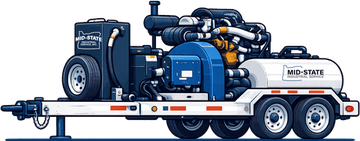
Mid-State operates a trailer-mounted Jetstream industrial waterblasting system to clean suitable tank interiors, vessels, and process equipment when vacuum recovery alone cannot remove hardened buildup.
- Controlled high-pressure water loosens hardened sludge, scale, residue, coatings, and process buildup from suitable tank walls, floors, and internal surfaces.
- Application-specific hoses, lances, nozzles, and operating settings are selected for the material and substrate.
- Hydroblasting for tank-entry work can be paired with the required ventilation, monitoring, isolation, communication, and entry controls.
- Industrial vacuum recovery removes loosened material, process water, sediment, and accepted debris from accessible collection points.
- Planned shutdown & maintenance support includes turnarounds, seasonal maintenance, pre-inspection cleaning, coating work, and tank repairs.
- Water-based cleaning may reduce reliance on abrasive media or chemical cleaners when the material, surface, and required result allow.
Best for: Industrial tank and vessel cleaning, sludge and scale removal, residue and coating removal, confined-space projects, pre-inspection cleaning, planned shutdowns, repairs, and maintenance preparation.
Service Areas
Mid-State Industrial Service provides industrial tank cleaning throughout Oregon. Crews and equipment can also mobilize for select projects in Southern Washington, Western Idaho, and Northern California.
Portland Metro
Multnomah, Washington & Clackamas counties.
Salem & Mid-Willamette Valley
Marion, Polk & surrounding counties.
Eugene & Springfield
Lane County & surrounding areas.
Bend & Central Oregon
Deschutes County & Central Oregon communities.
Roseburg & Southern Oregon
Douglas, Jackson, Josephine & surrounding counties.
Eastern Oregon
Mobilization available for mills, manufacturers, municipalities, processors, agricultural operations, and industrial facilities throughout Eastern Oregon.
Call (541) 726-6730 to discuss your facility location, tank contents, dimensions, access, confined-space status, cleaning requirements, waste plan, and schedule.
Frequently Asked Questions
How often should industrial tanks be cleaned?
Industrial tank-cleaning frequency depends on the stored material, tank design, buildup rate, product-change schedule, inspection requirements, sanitation program, corrosion concerns, and facility maintenance plan. Some tanks are cleaned during each product change or scheduled shutdown, while others are inspected and cleaned only when condition or operating requirements indicate the need. Mid-State can review the tank contents, history, access, and cleaning objective when developing the service scope.
Can you handle tanks with hazardous contents?
Mid-State reviews tanks with hazardous, flammable, corrosive, toxic, or unknown contents individually before accepting the work. The review may require safety data sheets, previous contents, testing or characterization, isolation information, atmospheric hazards, tank dimensions, access, waste codes, disposal options, and facility procedures. Some materials or conditions may require specialized subcontractors, equipment, permits, or disposal arrangements.
Do you handle waste disposal after cleaning?
Mid-State can coordinate transport, on-site transfer, processing, or disposal of accepted tank-cleaning material when included in the service scope. The handling plan depends on the material source, test results or characterization, volume, customer instructions, transportation requirements, receiving-facility approval, and applicable wastewater or waste rules. The customer may need to provide profiles, approvals, generator information, or other documentation before material can leave the site.
How far in advance should I schedule tank cleaning?
Schedule planned industrial tank cleaning as early as possible, especially when the work involves a shutdown, confined-space entry, waste profiling, specialized equipment, multiple contractors, or a fixed return-to-service date. Early planning allows time to review tank contents, access, isolation, cleaning specifications, waste handling, safety responsibilities, and scheduling. Mid-State also provides 24/7 emergency dispatch for urgent tank and liquid-recovery needs.
Can you coordinate tank cleaning during shutdowns or maintenance outages?
Yes. Mid-State coordinates industrial tank cleaning during planned shutdowns, turnarounds, seasonal maintenance, and facility outages throughout Oregon. Tank cleaning can also be scheduled with hydroblasting, industrial vacuum recovery, drain line jetting, and accepted waste handling. The facility remains responsible for determining when the tank or system is ready to return to service.
Does industrial tank cleaning always require confined-space entry?
No. Some tank-cleaning work can be completed from outside the tank using vacuum hoses, remote tooling, access ports, or other methods. When personnel must enter, the tank must be evaluated to determine whether it is a confined space or permit-required confined space, and the applicable Oregon OSHA and facility entry procedures must be established before work begins.
How does Mid-State clean industrial tanks?
Mid-State selects the tank-cleaning method based on the contents, buildup, tank material, access, internal components, hazards, and required result. Cleaning may involve industrial vacuum recovery, hydroblasting, manual removal, tanker support, containment, or a combination of methods. Waste and process water are handled according to the approved project plan.
What information is needed to quote an industrial tank-cleaning project?
Mid-State typically needs the facility location, tank dimensions, previous and current contents, safety data sheets, estimated sludge or liquid volume, access points, internal components, confined-space status, required cleaning result, available water and power, isolation plan, waste characterization, disposal location, shutdown schedule, photos, and customer specifications. A site visit may be needed before a firm scope and price can be prepared.
Safety-Focused Tank Cleaning for Demanding Industrial Environments
Planning a turnaround, inspection, coating project, product change, or urgent tank-cleaning response? Contact Mid-State to review the tank, material, safety requirements, waste plan, and schedule.
24/7 emergency dispatch available, statewide coverage across Oregon.