




High-Pressure Cleaning for Demanding Industrial Buildup
Hardened industrial buildup often requires more than routine pressure washing or manual cleaning. Hydroblasting uses controlled high-pressure water, application-specific tooling, and trained operators to remove scale, coatings, sludge, residue, and other deposits from suitable industrial surfaces and equipment.
Mid-State Industrial Service provides industrial hydroblasting throughout Oregon using a trailer-mounted Jetstream waterblasting system capable of operating at pressures up to 20,000 PSI. Our crews clean suitable tanks, vessels, trenches, piping systems, drainage infrastructure, heat-transfer equipment, and production machinery affected by scale, sludge, hardened residue, coatings, and accumulated process material.

Hydroblasting can reduce the need for chemical cleaners or abrasive media in suitable applications. When paired with containment and industrial vacuum recovery, loosened material and process water can be collected for controlled handling according to the facility’s requirements, the material characteristics, and the approved disposal or reuse plan.
We support planned shutdowns, outages, seasonal maintenance programs, emergency response work, and ongoing industrial cleaning operations for facilities throughout Oregon, including pulp and paper mills, food processing facilities, manufacturing plants, refineries, tank farms, and heavy industrial sites.
What Hydroblasting Removes
Hydroblasting cuts through stubborn buildup, coatings, and deposits that conventional cleaning methods cannot remove effectively. Using high-pressure water, it breaks apart and removes hardened material from industrial surfaces, process equipment, tanks, pits, and other areas where routine cleaning methods may not be sufficient.

- Scale and Mineral Deposits: Calcium, silica, rust scale, and process-related buildup on suitable industrial surfaces.
- Coatings and Linings: Paint, epoxy, rubber, and protective coatings selected for removal during surface preparation or maintenance.
- Process Residue: Food product, organic material, chemical residue, and other deposits from production equipment and systems.
- Corrosion Products: Rust, oxidation, and loose surface contamination.
- Refractory and Concrete Material: Loose, deteriorated, or specified material removed for repair, inspection, or reapplication.
- Sludge and Production Buildup: Accumulated material in pits, trenches, hoppers, digesters, tanks, and process systems.
Our Hydroblasting Process
Industrial hydroblasting equipment delivers high-pressure water cleaning for industrial shutdowns, surface preparation, line cleaning, and heavy industrial maintenance applications.
Pre-Job Survey
Before work begins, we review the equipment or surface to be cleaned, known material characteristics, access, water supply, containment needs, confined-space status, surrounding hazards, and the required cleaning result.
Detailed Proposal
If requested, you can receive a written scope of work outlining the equipment, cleaning approach, access requirements, containment plan, estimated schedule, staffing needs, and pricing before mobilization. We identify any exclusions, customer responsibilities, or special site requirements in advance.
Safe Setup
The crew establishes the required exclusion zones, equipment controls, PPE, containment, hose routing, communication procedures, and site-specific safety measures before cleaning begins. When confined-space entry is required, the team also coordinates the applicable entry permit, atmospheric testing, ventilation, attendant, rescue, and isolation procedures.
Hydroblasting
Trained operators use controlled pressure, flow, standoff distance, and application-specific tooling to remove the targeted buildup from suitable equipment and surfaces.
Waste Containment
Where included in the project scope, containment and vacuum recovery collect process water, sludge, residue, and loosened debris for handling according to the material source, facility requirements, receiving-location approval, and applicable wastewater or disposal rules.
Post-Job Verification
The completed cleaning area is reviewed against the agreed scope, and relevant conditions are documented before the facility determines whether the equipment is ready for inspection, repair, coating, reassembly, or return to service.
Who We Serve
Facilities can coordinate hydroblasting with drain line jetting, trench cleaning, catch basin cleaning, tank cleaning, and industrial vacuum recovery during shutdowns, outages, and scheduled maintenance periods. Combining related services through Mid-State may reduce the number of separate contractors and mobilizations required for the project.
Pulp & Paper Mills
Hydroblasting for roll cleaning, tanks, press sections, trenches, process equipment, and accumulated mill residue.
Food & Beverage Processing Facilities
Cleaning support for suitable vessels, tanks, production equipment, drains, and non-product-contact areas during sanitation or maintenance work.
Metal Fabrication & Manufacturing Plants
Scale removal, equipment cleaning, coating removal, and surface preparation for suitable machinery, structures, and production areas.
Energy Generation Facilities
Hydroblasting support for suitable boilers, heat exchangers, condensers, piping, and maintenance-related equipment.
Tank Farms & Storage Facilities
Interior tank and vessel cleaning, coating removal, residue removal, and preparation for inspection, repair, or relining.
Chemical & Industrial Processing Operations
Cleaning suitable reactors, tanks, vessels, piping, trenches, and process equipment after reviewing material, hazards, isolation, and cleaning requirements.
Municipal & Industrial Wastewater Facilities
Cleaning support for digesters, tanks, channels, pits, equipment, and wastewater infrastructure during maintenance and shutdown work.
Wood Products & Sawmills
Removal of buildup and production residue from suitable conveyors, pits, trenches, cyclones, tanks, and mill equipment.
Wineries, Breweries & Beverage Processors
Seasonal cleaning support for suitable tanks, trenches, drains, production equipment, and maintenance areas.
Hydroblasting for Confined-Space Projects

Tanks, vessels, digesters, pits, vaults, hoppers, and enclosed process equipment may qualify as confined spaces or permit-required confined spaces depending on their configuration and hazards. Each space must be evaluated before entry under the facility’s program and the applicable OSHA requirements.
When personnel entry is required, Mid-State coordinates trained entrants, attendants, supervision, atmospheric monitoring, ventilation, communication, isolation, lockout/tagout, rescue planning, PPE, and other required controls under the site-specific entry plan. Confirm responsibilities between the facility host, Mid-State, and any other contractors before work begins.
Industrial confined-space cleaning requires more than pressure washing equipment. It requires trained personnel, documented safety procedures, and close coordination with facility operations, maintenance teams, and shutdown schedules.
No Chemicals. No Abrasive Media. Water-Based Cleaning.
Hydroblasting can reduce the need for chemical cleaners and abrasive media in suitable applications. Depending on the project:
- Water-only cleaning may be used when the deposit, substrate, and required result allow.
- Water-only hydroblasting generates no expendable abrasive media.
- Process water and loosened material can be captured through containment and vacuum recovery when included in the project scope.
- Wastewater handling is planned based on the removed material, facility requirements, and the approved discharge, reuse, or disposal location.
- Additional cleaners, inhibitors, or treatment may still be required for certain deposits, surfaces, or facility specifications.
These options can help facilities plan cleaning around wastewater controls, waste minimization goals, sanitation requirements, and site-specific environmental procedures.
Why Choose Mid-State Industrial Service
Confined-Space Project Experience
Trained personnel and site-specific entry procedures are available when the work requires permit-space controls.
Integrated Industrial Services
Coordinate hydroblasting, tank cleaning, industrial vacuum recovery, drain line jetting, trench cleaning, and accepted material handling through one service provider.
Water-Only Cleaning Options
Suitable applications may reduce chemical use and eliminate expendable abrasive media, helping reduce secondary waste.
Shutdown & Maintenance Coordination
Experienced in coordinating work around planned shutdowns, outages, maintenance schedules, and active industrial operations to reduce avoidable disruption.
24/7 Emergency Dispatch
After-hours dispatch for urgent industrial cleaning needs, subject to equipment availability, access, material conditions, and site requirements.
Statewide Coverage
Serving industrial facilities throughout Oregon, with crews and equipment available for projects in the Portland Metro area, Willamette Valley, Central Oregon, Southern Oregon, the Oregon Coast, and Eastern Oregon. Extended mobilization may also be available for select projects in neighboring states.
Equipment Used for Hydroblasting
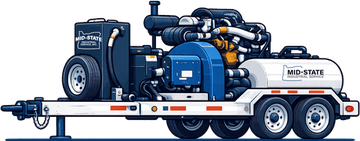
Mid-State operates a trailer-mounted Jetstream industrial waterblasting system for high-pressure cleaning of suitable tanks, vessels, piping, process equipment, drainage structures, and industrial infrastructure.
- Controlled high-pressure waterblasting for industrial cleaning, coating removal, and surface-preparation applications.
- Application-specific lances, nozzles, hoses, and tooling selected for the material and surface.
- Scale, sludge, residue, coatings, and process-material removal from suitable surfaces.
- Tank, vessel, piping & production-equipment maintenance for trenches, condensers, and other industrial equipment.
- Containment & industrial vacuum recovery for process-water and debris collection.
- Planned shutdown, maintenance & urgent cleaning support for outages, production support, and time-sensitive cleaning needs.
Best for: Industrial hydroblasting, tank and vessel cleaning, process-equipment cleaning, coating and scale removal, suitable surface preparation, piping-system cleaning, shutdown support, and industrial maintenance.
Service Areas
Mid-State Industrial Service provides industrial hydroblasting throughout Oregon. Crews and equipment can also mobilize for select projects in Southern Washington, Western Idaho, and Northern California.
Portland Metro
Multnomah, Washington & Clackamas counties.
Salem & Mid-Willamette Valley
Marion, Polk & surrounding counties.
Eugene & Springfield
Lane County & surrounding areas.
Bend & Central Oregon
Deschutes County & Central Oregon communities.
Roseburg & Southern Oregon
Douglas, Jackson, Josephine & surrounding counties.
Eastern Oregon
Mobilization available for mills, manufacturers, utilities, processors & industrial facilities throughout Eastern Oregon.
Call (541) 726-6730 to discuss your facility location, equipment or surface, material buildup, access, water supply, containment needs, and project schedule.
Frequently Asked Questions
What pressure levels do you use for hydroblasting?
Mid-State’s Jetstream hydroblasting equipment can operate at pressures up to 20,000 PSI. The actual pressure, flow, nozzle, tooling, and standoff distance are selected based on the material being removed, the surface condition, access, containment needs, and the required cleaning result. Higher pressure is not automatically better, because an inappropriate setup can damage equipment or create additional hazards.
Can you work inside tanks and enclosed vessels?
Yes. Mid-State can perform hydroblasting in qualifying tanks, vessels, pits, vaults, and other confined spaces when a site-specific entry plan and the required safety controls are in place. Depending on the space, the work may require atmospheric testing, ventilation, isolation, lockout/tagout, trained entrants, an attendant, entry supervision, rescue planning, and coordination with the facility’s confined-space program.
Do you work during planned shutdowns?
Yes. Mid-State schedules hydroblasting, tank cleaning, industrial vacuum recovery, and related cleaning work during planned shutdowns, outages, and maintenance windows throughout Oregon. Contact us early with the equipment list, access conditions, cleaning specifications, required completion date, and other contractors working during the shutdown.
How do you handle the wastewater generated?
Hydroblasting wastewater is handled according to the removed material, contaminants present, facility requirements, containment plan, and approved receiving location. Mid-State can provide containment, vacuum recovery, transport, or on-site transfer when included in the service scope. Discharge to a sanitary sewer generally requires approval from the local sanitary authority, while discharge to land or waters of the state may require Oregon DEQ authorization.
Can hydroblasting damage industrial equipment or coatings?
Hydroblasting can damage a surface when the pressure, flow, nozzle, standoff distance, or technique is inappropriate for the substrate. Mid-State reviews the material being removed, surface condition, coating specification, equipment design, and required cleaning result before selecting the operating setup. A test area or customer approval may be appropriate for sensitive or unfamiliar surfaces.
Does industrial hydroblasting use chemicals or abrasive media?
Many hydroblasting projects use high-pressure water without chemical cleaners or abrasive media. Some applications may still require approved additives, corrosion inhibitors, detergents, pretreatment, or a different surface-preparation method based on the deposit, substrate, coating specification, sanitation requirements, and wastewater plan.
What information is needed to quote an industrial hydroblasting job?
Mid-State typically needs the facility location, equipment or surface to be cleaned, material buildup, dimensions, access, required cleaning result, available water source, containment needs, wastewater plan, confined-space status, shutdown schedule, photos, and any customer or manufacturer cleaning specifications. A site visit may be needed before a firm scope and estimate can be prepared.
Remove Buildup Before It Disrupts Your Operation
Planning a shutdown, equipment cleaning, coating-removal project, or urgent maintenance response? Contact Mid-State to review the scope and scheduling requirements.
24/7 emergency dispatch available, with statewide coverage across Oregon.