How often should you schedule it (& why it’s not optional)
When catch basins fill up, the consequences are predictable and progressive. Water ponds on paved surfaces. Storm drains back up and overflow. Sediment moves downstream, carrying pollutants into waterways. And eventually, someone makes an emergency call that costs far more than routine maintenance ever would have.
Catch basin cleaning isn’t complex, but it often gets deferred until a visible problem arises. For Oregon facility managers, public works directors, and construction contractors, that deferral carries real risk — both operationally and from a regulatory standpoint.
What catch basins actually do
Catch basins are the inlet structures you see at curbs, in parking lots, and along roadways. They capture surface runoff and channel it into the storm drain system before it reaches waterways. Along the way, they act as a first line of defense against pollution, trapping sediment, debris, oil, and other materials that would otherwise wash directly into rivers and streams.
The problem is that they fill up. Over time, sediment accumulates at the bottom of the sump, floating debris clogs the inlet, and the basin loses its ability to function. When that happens, water backs up, pollutants pass through, and the facility becomes a liability rather than an asset.
How often should you schedule catch basin cleaning?
No single schedule works for every site. Most sites fall into one of these tiers:
High-debris sites (construction zones, industrial yards, facilities near vegetation): quarterly service to keep basins functional year-round
Typical commercial properties (parking lots, retail centers, office campuses): one to two cleanings per year, timed around Oregon’s rainy season
Municipal systems and high-flow locations: seasonal service aligned to inspection schedules and permit requirements
A few situations always warrant immediate service: after significant storm events, after construction activity increases sediment loads, and whenever a sump approaches 50% capacity — the BMP threshold at which flow restriction becomes a real concern.
Signs your catch basins are overdue
- Standing water near drain inlets after moderate rain
- Visible debris, sediment, or floating material inside the basin
- Slow drainage or water pooling on paved surfaces longer than expected
- Odors near storm drain inlets, indicating organic buildup
- Grates that are partially blocked or show evidence of overflow at the curb line
What the cleaning process involves
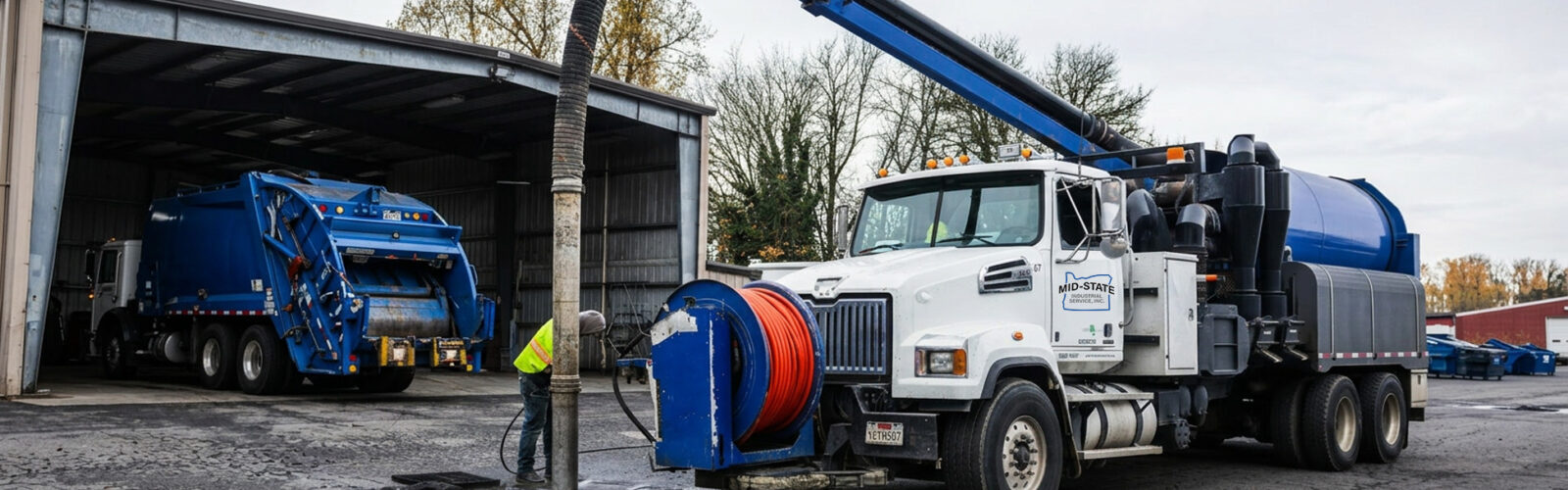
Professional catch basin cleaning is a vacuum-based process. A combination vacuum and jetting truck arrives, breaks up compacted sediment using high-pressure water, and vacuums material into an onboard tank for proper disposal.
Inspection — Assessing the inlet, grate, and sump for condition and fill level
High-pressure jetting — Loosening sediment, grease, and debris from basin walls and the sump floor
Vacuum extraction — Removing all loosened material
Disposal — Hauling waste to an approved facility; regulated or contaminated material requires profiling and testing under Oregon DEQ guidelines
Condition reporting — Noting structural damage, cracked walls, or deteriorating inlet grates
Mid-State crews document each service, giving you a written record for permit compliance and internal maintenance tracking.
Stormwater compliance & NPDES requirements
Catch basin cleaning is not just a maintenance task. For many Oregon facilities, it is a regulatory requirement.
Facilities operating under NPDES permits, MS4 permits, or SWPPPs typically must demonstrate regular storm drain inspection and maintenance. Oregon DEQ enforces stormwater regulations at both the state and local levels. Neglecting documentation can result in permit violations, fines, and corrective action orders. A professional service record from a certified contractor provides the documentation that holds up during regulatory audits.
Why facility managers choose Mid-State Industrial
Mid-State Industrial Service has provided catch basin cleaning and storm drain maintenance throughout Oregon since 1970—55+ years of hands-on experience in a state with demanding environmental requirements and highly variable weather.
We operate a fleet of more than 35 GPS-tracked service trucks, available 24/7 for scheduled maintenance and emergency response. Our certifications include NAPSA (sweeping and vacuum), NASSCO (CCTV inspection), D2000 (confined space). Licensed in Oregon (CCB #239935). Member of the 1-800-SWEEPER national network.
Ready to schedule a catch basin cleaning service?
Contact Mid-State Industrial Service. We serve all of Oregon, with same-day availability for urgent needs and flexible scheduling for routine contracts.
Call Mid-State Industrial Service, Inc. at (541) 726-6730 or Request a Quote for scheduling and availability.
We Handle The Dirty Work, So You Don’t Have To.